artifacts of empire
Artifacts of Empire premiered in the Kling Family Gallery at Lambert St. Louis airport in 2024, during the 120th anniversary of the 1904 World's Fair in St. Louis. The collection embodies the idea of narratives as both instruments and products of empire and explores how imperialism and capitalism shape the evolution of culture and identity.
select work

Dressed Cost, 2024
collaboration with Rockie Sharon
aluminum, copper, cotton fabric, dried flowers, moss, plastic
Ria sculpts the iconic Filipino terno in steel and copper, its metal sleeves holding a quiet conversation across time: the artist gazing backward into memory, while her maternal grandmother Carmen Araneta, looks steadily ahead. Within the metal cage, dried roses and moss blur the lines between preservation and decay, while a skirt printed with pages from classic literature and three hundred plastic army men weave a silent march through history. The title, Dressed Cost, a nod to a butcher's measure of flesh and bone after slaughter—the gown stands as a poetic monument to living history and family being carved down into commodities for consumption.
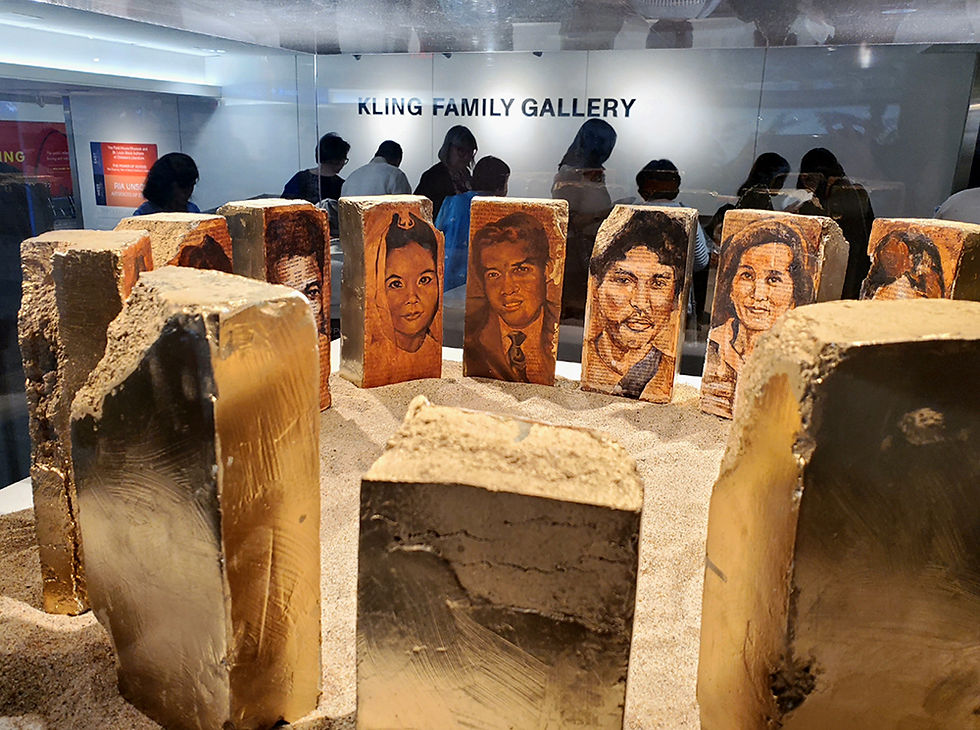
Foundation, 2024
acrylic paint and image transfers on 13 bricks on a bed of sand
Clay from St. Louis was baked into the red bricks that built a rising nation; across the ocean, a parallel extraction unfolded in Philippines, the country mined of people. Here, thirteen portraits of first-generation Filipino Americans reclaim their sovereignty, standing as the living bedrock of St. Louis’ present-day community. Painted over transferred newspaper stories of contemporary Filipino lives, these faces emerge directly from century bricks (mined in the early 1900's)—elders gathered in a sacred circle, their presence initially obscured like hidden bars of gold; revealing the labor and resilience sealed within the foundations of history.

Mementos, 2023
paper, glue, and found objects (silver spoons, ceramic and glass dishes, metal vase, tin can, stone egg)
William Taft, governor-general of the Philippines in 1904 and future U.S. President called the World's Fair "a great influence in completing the pacification of the Philippines." The fair was meant to win over the American public who opposed the invasion and occupation of a sovereign nation. Understanding souvenirs to be powerful tools that contribute to the enduring memory of the 1904 fair, Unson uses this form as the canvas on which to re-remember, wrapping fair souvenirs with newspaper headlines of atrocities of the Philippine American War that were deliberately obfuscated by the fair's bright lights and giant Ferris Wheel.
about the exhibition
The work unearths the persistent ghosts of 1904, when St. Louis played host to the World’s Fair and offered the Philippine exhibit as living proof of a rising empire—a grand spectacle designed to justify invasion, occupation, and the subjugation of a people. Marking the fair’s 120th anniversary, Artifacts of Empire serves as a mirror held up to America’s imperial soul, tracing how the wounds of that era still echo in our collective memory and in Ria’s own bloodline, where four generations carry the lingering legacy of her great grandfather's early indoctrination. By dismantling the written word—the very weapon used to erase Filipino culture during the occupation—she fractures linear text into tactile art, layering found objects, collage, and portraiture to weave a counter-narrative against the Western canon. In this visual reclamation, she asks who holds the power to shape memory, who profits from the tales we memorialize, and what kind of world we are weaving for those who will look back on us a century from now: a future that holds up the collective whole, or one that serves only the privileged few?